
A clear pattern is emerging across manufacturing: AI adoption is no longer optional.
It is being driven simultaneously from the boardroom, the factory floor, and increasingly from government priorities focused on industrial competitiveness.
But as manufacturers rush toward deployment, many are confronting a foundational question they should have answered first:
What is the single source of truth inside our operation?
Because AI does not fix fragmentation, it operationalizes whatever foundation already exists.
For leading manufacturers, that foundation is rapidly becoming the model.
Assembly of the Week
This week’s assembly instructions powered by BuildOS is a double acting oscillating steam engine.

Rate this CAD Model in BuildOS
If you have a favorite CAD assembly you’d like us to feature, reply to this email. We love seeing what people are building.
Industry Signals
1️⃣ Anduril Selects Dirac to Power AI-Driven Work Instructions Across Its Factories

2️⃣ Dirac Automates the Final Frontier: From CAD Model to Work Instructions
In this interview, Dirac CEO Fil Aronshtein discuss the first instance of a CAD-like tool for manufacturing and industrial engineers.
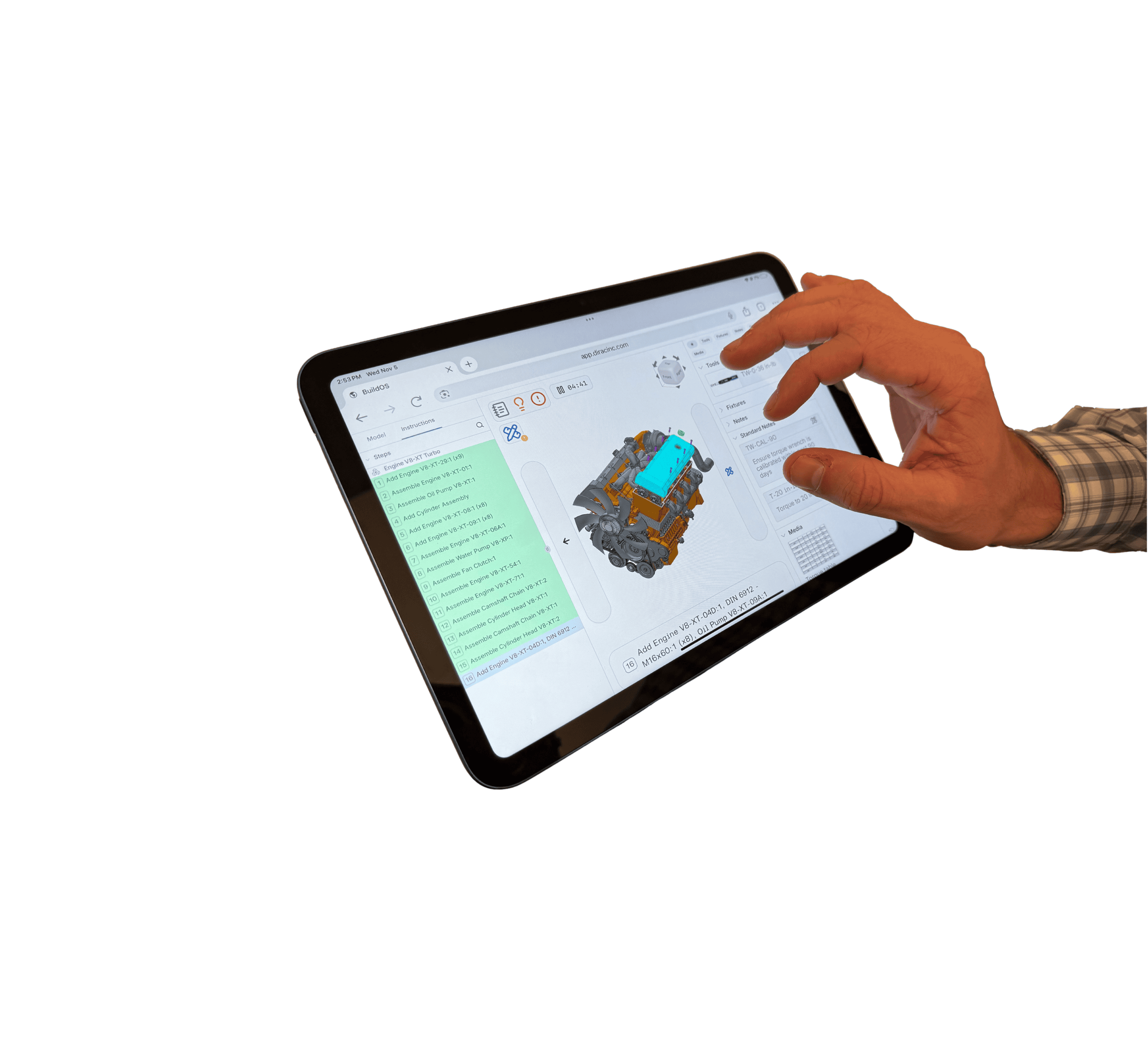
Dirac’s BuildOS platform is closing a critical gap in the model-based thread: the handoff between design and production. By using AI to generate structured work instructions directly from CAD assemblies, Dirac eliminates the manual, error-prone translation that has long slowed down manufacturing execution. This marks one of the first truly CAD-native tools for manufacturing engineers, enabling real-time updates and reducing instruction generation time by over 90%.
3️⃣ SodiusWillert: Building the Digital Thread Across Disciplines

SodiusWillert highlights the importance of establishing a digital thread to connect multidisciplinary engineering efforts. Their SECollab platform facilitates end-to-end traceability, cross-disciplinary data alignment, and configuration management, ensuring that model-based engineering delivers value throughout the product lifecycle.
By integrating tools and processes, organizations can achieve a unified view of their engineering data, enhancing collaboration and compliance.
4️⃣ Zoomlion’s Smart Factory: A Blueprint for Scalable, AI-Driven Manufacturing

Zoomlion’s Changsha excavator plant exemplifies the power of a unified digital manufacturing strategy. Operating under a “one blueprint” approach, the facility integrates AI-driven scheduling, flexible workstations, and real-time logistics to produce over 100 different excavator models on a single line without stoppages.
This consolidation into a single source of truth has significantly improved predictability, capacity, and business agility, setting a new standard for heavy equipment manufacturing.
“Model-Based Manufacturing” in a Nutshell
Model-based manufacturing is an approach where the 3D product model (and its associated data) is the primary source of truth that flows from design into production, quality, and service. Instead of re-interpreting CAD into static documents (PowerPoints, PDFs, workbooks), the model drives:
Process planning & work instructions (how things get built)
Bills of Material (what’s needed and in what structure)
Tooling & fixtures context (how work is actually done on the floor)
Feedback loops from the line back into design
In short: the digital model is the operating system for how you build, inspect, and service the product.
That’s the world we’re betting on, and much of the news below points in that direction too.

Thanks for reading this issue of The Model-Based Manufacturer.
See you in two weeks.
— The Dirac Team