
Hi there,
Happy Holidays from Dirac! Instead of sugar-plums, we have visions of end-to-end model-based manufacturing dancing in our heads.
Welcome to this week’s issue of The Model-Based Manufacturer— landing in your inbox just as year-end shutdowns, maintenance windows, and last-minute rush orders collide on the shop floor.
Let’s dive in.
Assembly of the Week
Rocking Horse Assembly

Powered by BuildOS
Rate this CAD Model in BuildOS
If you have a favorite CAD assembly you’d like us to feature, reply to this email!
Industry News We’re Watching
1. Paris Air Show, 17,000 aircraft, and the digital thread
Following the Paris Airshow this year, PTC put together this report on how the digital thread is becoming essential for aerospace and defense ramp-ups. PTC highlights how tools like Creo and Windchill, combined with tightly integrated Ansys simulation, are being used to accelerate production rates.
The digital thread is the longitudinal spine; model-based manufacturing is what happens when that spine actually lands on the shop floor as 3D-driven work instructions, MBOM/TBOM, and context-aware planning. If 2025 was about proving the digital thread in aerospace, 2026 is going to be about operationalizing it at rate — so operators aren’t still working off screenshots of PLM.
2. Palantir & L3Harris: AI-powered production
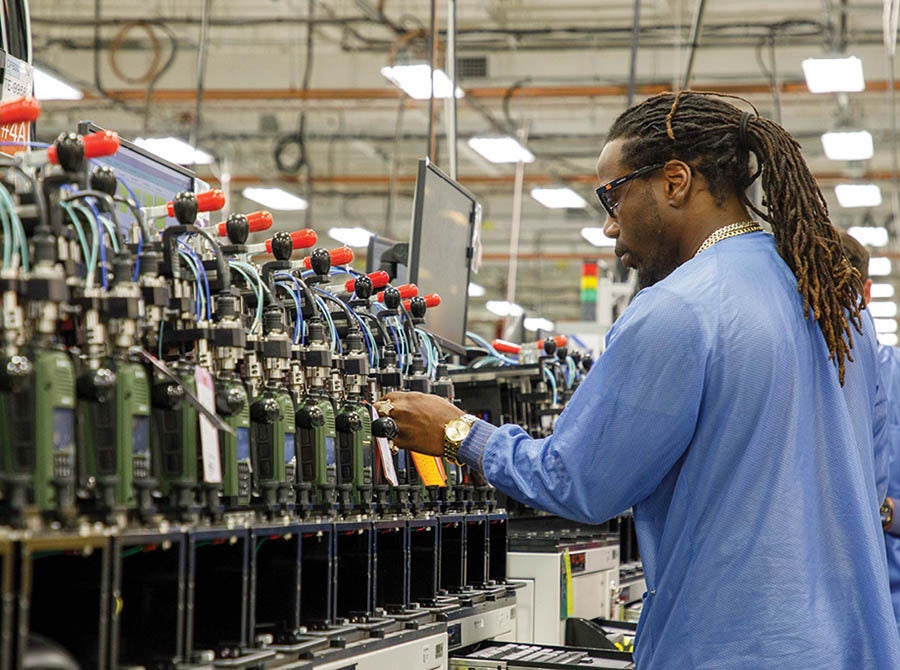
L3Harris and Palantir have been working together for a couple of years; this month, they shared more results on how they’re reindustrializing defense through AI-powered production. They have shown improvement across supply chain, BOM management, and more. We’ll be watching closely to see if and how this partnership evolves from AI dashboards into more model-native planning and execution.
3. Lockheed Martin x Hadrian: model-native parts as a service

Lockheed Martin and Hadrian announced a memorandum of understanding to advance manufacturing capabilities and increase missile parts production. Hadrian brings an aggressively automated, “factory-as-a-service” model built around software-defined machining and inspection cells. The goal: more output, shorter lead times, and a more resilient supply chain through advanced robotics, real-time execution software, and a model-driven production environment.
Hadrian is effectively positioning itself as the contract manufacturer for model-based parts: you send rich, well-defined models, and their software handles the rest. For OEMs, that pushes the ecosystem toward better PMI, cleaner MBOMs and process data, and a future where “send us the drawing package” becomes “send us the model and we’ll sync via digital thread.” Model-based manufacturing is no longer just an internal aspiration; it’s quickly becoming a baseline expectation for suppliers.
A Quick “Model-Based Moment” (Holiday Edition)
As lines slow down for the holidays and teams sneak in maintenance, it’s a rare chance to ask:
“If three of my most experienced people retired tomorrow, how much of our build process would actually be preserved in our systems?”
Model-based manufacturing gives you a concrete answer:
Work instructions tied directly to the 3D model
MBOM/TBOM that know what’s needed and how it’s used
Fixtures & tooling context captured explicitly, not just in someone’s memory
Feedback loops from the line that keep those models current
The goal for 2026 isn’t just more automation; it’s less fragile knowledge.

How do you think Santa’s production outpaces everyone else’s? The answer is obvious to us: model-based manufacturing.
Wishing you a restful holiday season and a Happy New Year!
See you in January,
— The Dirac Team