
Shipbuilding had a busy week, and the pattern is hard to miss. Everyone wants more capacity, and the interesting part is how they plan to get it.
The big moves are AI infrastructure, 3D model standards, and production data rather than new cranes or new dry docks. HD Korea Shipbuilding is pairing 200 million engineering records with Naver's AI stack. Dassault and AITAC are working to make the 3D model the official document for class approval, and in Washington, the argument is growing that the U.S. Navy's throughput problem is really a data problem.
The common thread across all three stories is that the yards treating their models as the source of truth are the ones positioned to build faster. Here's what caught our attention this week.
Assembly of the Week
Planetary Gearbox

This week’s assembly instructions powered by BuildOS is a planetary gearbox assembly.
Rate this CAD Model in BuildOS
If you have a favorite CAD assembly you’d like us to feature, reply to this email. We love seeing what people are building.
Industry Signals
HD Korea Shipbuilding wants an AI shipyard

HD Korea Shipbuilding & Offshore Engineering signed an MOU with Naver Cloud to build cloud and AI infrastructure purpose-built for shipbuilding. The scope covers AI factories, smart shipyards powered by physical AI, robotics, and software-defined vessels that can be controlled and operated through software after construction.
The foundation is data. HD Hyundai holds more than 200 million shipbuilding and offshore engineering records, and the partnership pairs that database with Naver's AI stack to speed up vessel design, production, and R&D. A joint team will identify AI applications, test the technologies, and train specialists. The two companies are also working the power side, using HD Hyundai's engine technologies, energy storage systems, and hydrogen fuel cells to develop power supply systems for data centers.
Naver Cloud's CEO framed the shipbuilding-specific AI foundation as a model that could expand to other industries. HD Korea Shipbuilding's CEO put it more directly: the goal is an intelligent, AI-powered smart shipyard.
Dassault Systèmes and AITAC push model-based ship approval

Dassault Systèmes partnered with marine engineering firm AITAC to build out support for Open Class 3D Exchange (OCX), an open data standard that replaces traditional 2D structural drawings with interactive 3D models. AITAC will lead development and commercialization of OCX eXchanger, a system for moving OCX data in and out of Dassault's 3DEXPERIENCE platform.
The target is the approval process. OCX adoption is growing industry-wide as a method of 3D model-based approval, letting shipyards, designers, and classification societies exchange vessel structural information in a standardized digital format instead of 2D drawings. Users of the 3DEXPERIENCE platform will be able to import, export, and manage OCX-compliant data directly from their digital twin environment, cutting manual data prep between design and classification. Ultimately, shipbuilding is rapidly moving toward model-based engineering and model-based approval.
The digital thread argument hits Washington
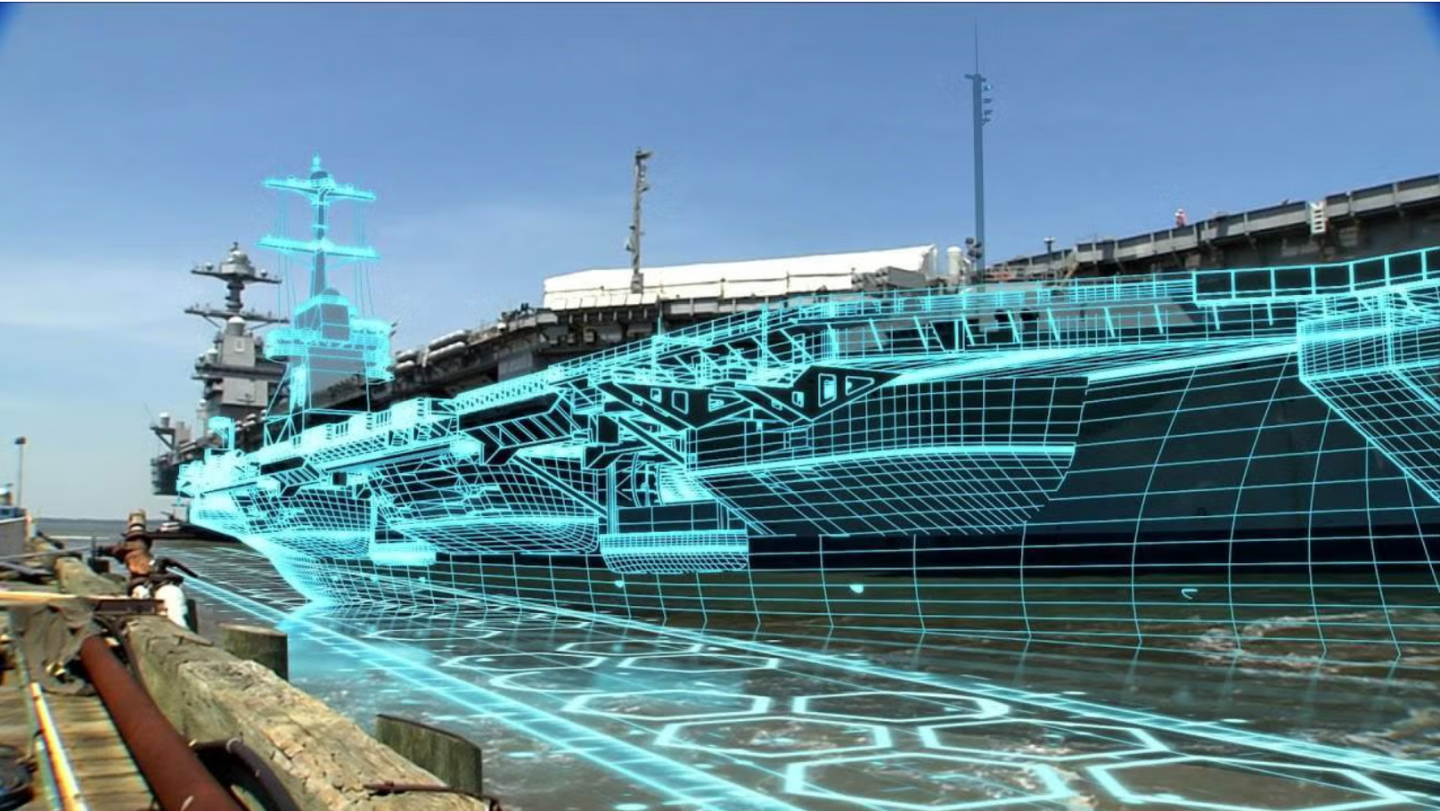
A RealClearDefense op-ed from retired Coast Guard Captain Brian McSorley opens with a sharp contrast: Hanwha Ocean is building warships in South Korea with integrated digital models, robotic inspection, and real-time production data feeding into maintenance systems, while the U.S. Navy has 75 Arleigh Burke destroyers in service and cannot find two in the same configuration.
His argument is that the fix is the digital thread: a single authoritative evidence chain linking design, manufacturing, inspection, maintenance, and modernization into one continuously updated environment. He points to what happens without it. The Constellation-class frigate started construction before a stable design was achieved and the lead ship is roughly three years behind schedule and 26 percent over its original price tag. The Coast Guard's Offshore Patrol Cutter followed the same pattern.
Retrofitting is brutal. Over 200 ships in service lack digital models, and government and industry spent more than $600 million trying to digitize a Ford-class carrier built on analog drawings. His bottom line: the digital thread must be treated as enabling infrastructure for maritime power, not an IT add-on procured after the hull contract is signed.
Capacity is the goal, but data is the plan. HD Korea is betting that its 200 million engineering records can train an AI shipyard, while Dassault and AITAC are betting that classification societies will approve a 3D model faster than a stack of drawings. Meanwhile, the argument taking hold in Washington is that the U.S. can't out-build anyone until every ship has a digital record worth trusting.
None of this replaces welders, fitters, or dry dock space. Instead, it makes them count for more. The yards moving first on model-based workflows are buying themselves throughput that the rest of the industry will spend years chasing.
We'll keep tracking who's actually shipping versus who's still announcing.
See you in two weeks.
— The Dirac Team